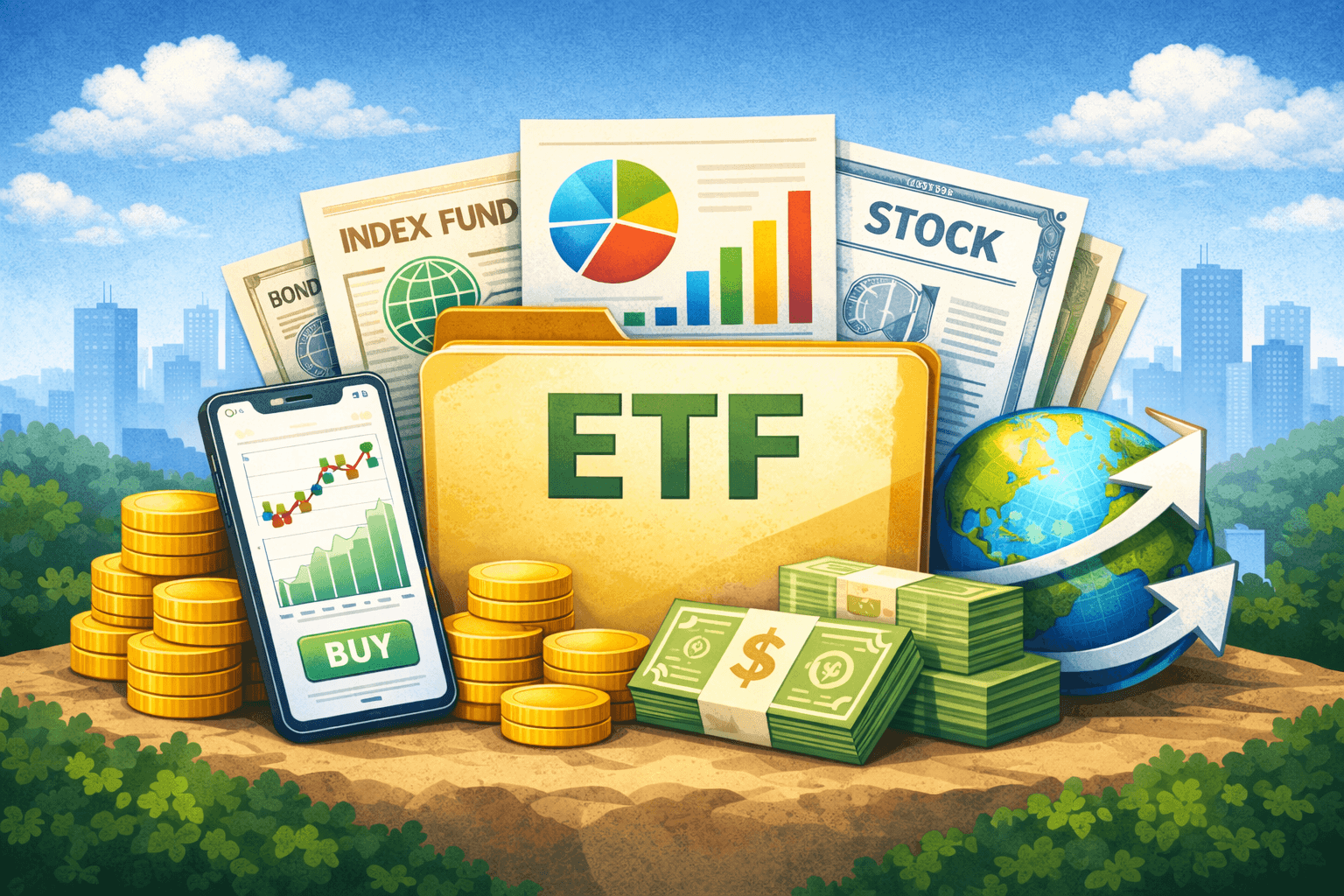
Exchange-traded funds (ETFs) are one of the simplest, cheapest, and least stressful ways to invest.
They're so good that Warren Buffett, the wealthiest investor of all time, says most investors should just buy an ETF and "call it a day."
So what's all the hype about? Let's break it down.
What are ETFs?
Think of investing like making a fruit salad. 🍉
- First, you have to decide on the fruit you want. Apples, bananas, watermelon...
- Then, you have to pick the individual fruit out of the bunch, making sure they’re ripe.
- Finally, you have to cut them all up and mix them together.
Luckily, if you're low on time, on a budget, or unsure about your fruit selection skills, you can just buy it premade.
An ETF is just like a premade fruit salad for investing.
ETFs are professionally managed investment funds that hold multiple underlying assets (stocks, bonds, commodities, etc.), and can be bought and sold on exchanges just like stocks.
By buying an ETF you get to own a little bit of every asset in the fund.
This saves you going out and buying them all yourself, which would be expensive (brokerage fees) and time consuming!
ETFs are investment funds that hold a group of underlying assets and can be bought and sold on exchanges just like stocks.
Types of ETFs
Index ETFs
Index ETFs aim to track the performance of whole asset classes, markets, or sectors.
Here are some examples:
- SPDR S&P 500 ETF (the first ETF ever listed in the US) - aims to track the performance of the 500 largest stocks in the US
- iShares Core Composite Bond ETF - aims to track the performance of the Australian bond market
- Vanguard Information Technology ETF - aims to track the performance of stocks in the information technology sector
Thematic ETFs
ETFs can also focus on a specific investment theme or trend, such as AI, cloud computing, or renewable energy.
They can hold assets from different markets and sectors, but which are all anticipated to benefit from a common macroeconomic trend.
Some examples include:
- Global X Artificial Intelligence ETF - invests in companies that stand to benefit from widespread adoption of artificial intelligence technology
- Betashares Energy Transition Metals ETF - invests in companies related to the global shift from fossil fuels to renewables
Active ETFs
Instead of simply trying to track performance, active ETFs attempt to buy and sell assets in order to outperform a particular benchmark.
This is
Ready-made ETFs
ETFs can also be designed to fulfill a certain role inside your portfolio, or serve as your whole portfolio all by themselves!
For example, the Vanguard Diversified Growth Index ETF is a professionally designed portfolio of other ETFs designed to be suitable for investors with a higher risk tolerance and an objective for growth.
Diversification
The beauty of ETFs is that they let you invest in a large group of assets at the same time.
And this lets you take advantage of a little thing called diversification. ✨
If one asset in the fund performs poorly, the others can help to balance it out so that the overall impact on your portfolio is minimal.
The broader the ETF and the more assets it holds, the more protection you have against any one of them performing badly.
This makes ETFs a great option for beginners.
How much do ETFs cost?
Running an investment fund is hard work.
ETF managers charge a small annual fee, which is usually a percentage of the size of the fund.
But the bill is not sent in the mail. Instead, it's discretely deducted from the fund itself.
This is reflected in the ETF's price over time.
When you buy an ETF, you're hoping that the value of the fund grows by more than the management fee so you can sell it for more than you bought it.
This article is intended for educational purposes only. The information provided is general in nature and does not consider your personal financial circumstances. Please consult a certified financial advisor if you require advice.